

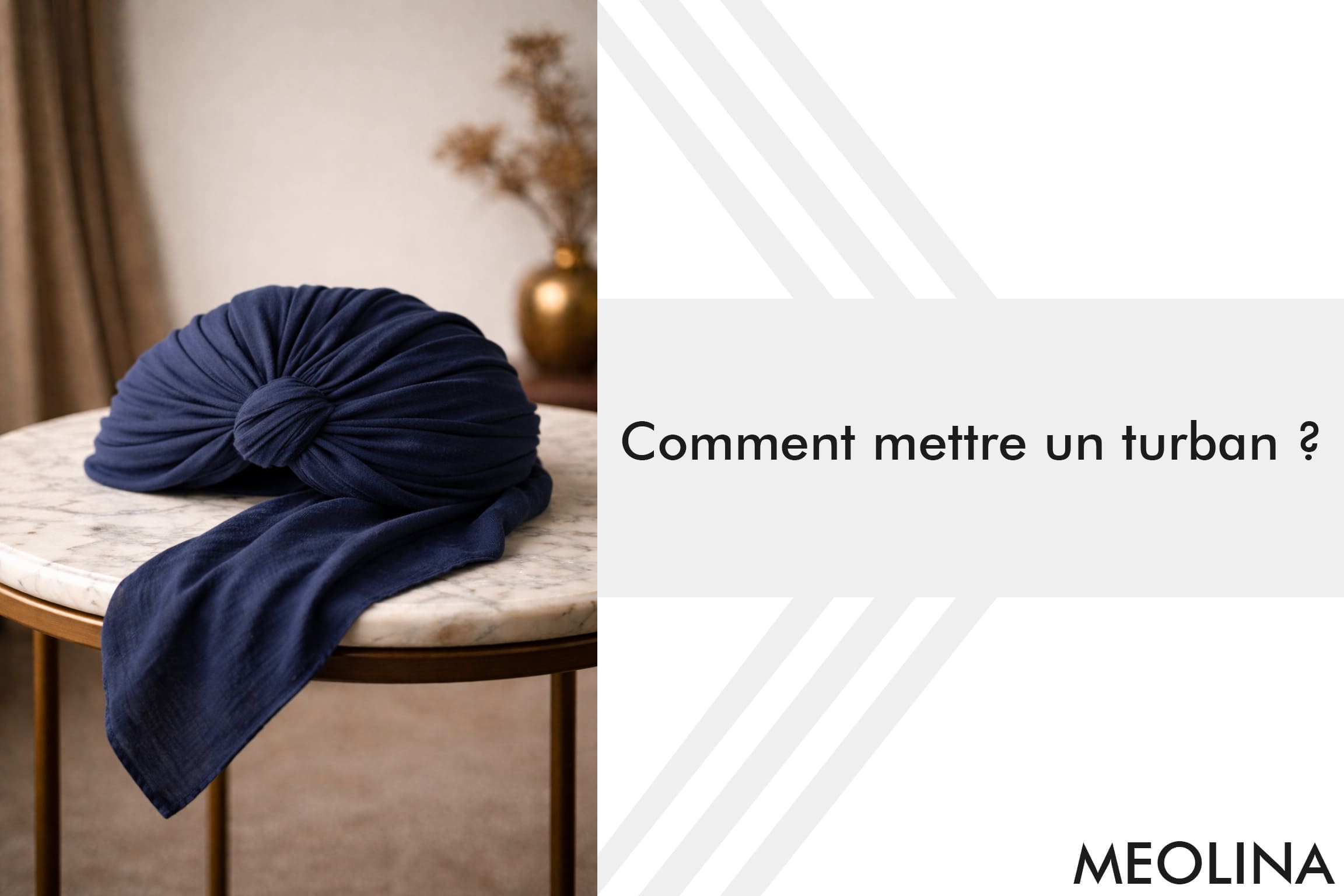
How to tie a turban?
Today, turbans come in two main forms. Some are pre-shaped hats, while others are scarves made of long pieces of fabric that are tied around the head.
Turban hats are distinguished above all by their ease of use. Their shape is pre-established, making them very easy to wear: simply slip them on to achieve the desired effect immediately. This type of model is appealing for its practicality and speed of application.
Conversely, turbans made from a scarf need to be tied. The long pieces of fabric must be crossed, twisted, or tied using different techniques. While they require a few extra steps to put on, they offer a wide variety of styles and tying options.
In this article, we will look at the different ways to wear a turban scarf for women, presenting five methods in detail, step by step.
How to tie a turban scarf?
Crossed style

The crossed turban is distinguished by the intertwining of the fabric on top of the head, creating a structured and harmonious effect. This style highlights the volume of the scarf while ensuring effective support.
Position the scarf
Place the center of the scarf at the back of the head, at the nape of the neck, so that it covers the hair properly. The two ends should be of equal length and fall on either side of the head.
Bring the ends forward
Grasp both ends of the scarf and bring them forward to the front of your head, making sure the fabric remains flat against your skull.
Cross the ends
At the forehead, cross the two ends over each other. This cross is the central element of the turban and creates the characteristic visual effect of this style.
Bring the ends back
After crossing them, bring each end to the back of the head, keeping them taut to maintain a neat and balanced structure.
Tie the turban
Tie the two ends at the back of the head, at the nape of the neck, using a single or double knot depending on the length of the fabric.
Adjust the look
Adjust the fabric if necessary to even out the folds and distribute the volume evenly. The cross at the front should remain clearly visible and symmetrical.
With knot

The knotted turban is distinguished by the presence of a visible knot, usually positioned at the front of the head. This style creates a structural point that adds dimension to the turban while remaining relatively simple to put on.
Place the scarf
Place the center of the scarf at the back of the head, at the nape of the neck, making sure to cover the hair completely. The two ends should fall on either side of the head with equal length.
Bring the ends to the front
Grasp both ends of the scarf and bring them forward to the front of the head, making sure to hold the fabric tightly against the skull.
Form the knot
At the forehead, make a simple knot with the two ends of the scarf. It should be positioned in the center to create a balanced look.
Adjust the knot
Tighten the knot slightly to secure the turban while maintaining a harmonious volume. The knot can be loosened slightly to create a more flexible effect.
Arrange the ends
Depending on the length of the scarf, the ends can be tucked under the fabric of the turban or left slightly visible to add volume.
Finalize the adjustment
Smooth the fabric around the head and adjust the folds to achieve a structured turban and a knot that is well positioned in the center.
Twisted effect

The twisted turban is characterized by the fabric being wrapped around itself, creating a twisted effect that adds texture and an elegant structure to the overall look. This technique creates a refined and well-maintained finish.
Set the scarf in place
Place the center of the scarf at the back of the head, at the nape of the neck. The two ends should be of equal length and fall on either side of the head.
Bring the ends forward
Bring the two ends of the scarf forward, making sure that the fabric covers the hair and remains properly adjusted.
Twist the ends
Take the two ends of the scarf and twist them together, wrapping them around each other. The twist should be even to achieve a harmonious look.
Position the twist
Place the twist on top of your head, holding it firmly in place.
Secure the turban
Bring the remaining end to the back of your head and slide it under the fabric already in place or tie it at the back, depending on the length of the scarf.
Adjust the shape
Adjust the twist and distribute the fabric to achieve balanced volume and a comfortable fit.
Tied at the back

This style of turban is characterized by a knot at the back of the head, leaving one side of the fabric to fall freely. The result is fluid and gives the scarf a natural movement.
Position the scarf
Place the center of the scarf on the top of your head so that both sides fall toward the back.
Adjust the fabric
Pull the scarf back slightly so that it covers the head properly and keeps the hair in place, while remaining snug.
Gather the ends
Bring the two ends of the fabric to the back of the head, at the nape of the neck, keeping them flat.
Tie the knot
Tie the two ends together at the back of your head with a single or double knot to secure the turban.
Let the fabric fall
Depending on the length of the scarf, let part of the fabric fall freely behind your head to create the characteristic effect of this style.
Adjust the whole thing
Smooth the fabric over the top of your head and adjust the hanging end to achieve a balanced and harmonious look.
Large models

Voluminous turbans are characterized by a large amount of fabric that allows for generous folds and a fuller structure on top of the head. This type of tying relies mainly on how the fabric is arranged and distributed in order to achieve a balanced and harmonious volume.
Place the scarf
Place the center of the scarf at the back of the head, at the nape of the neck, letting the two ends fall down on either side. A long or wide scarf is particularly suitable for creating volume.
Bring both ends forward
Bring the two ends forward to the front of the head, keeping the fabric slightly loose to preserve the material needed to create volume.
Layer the fabric
Arrange the fabric on top of your head, layering it slightly to form natural folds.
Adjust the distribution of the fabric
Distribute the folds and adjust the fabric to achieve a balanced structure. The volume can be concentrated in the center or slightly spread out, depending on the desired effect.
Tie the turban
Bring the ends of the scarf to the back of the head and tie them at the nape of the neck to hold everything in place.


Leave a comment